

2026 Cobb County, GA Primary Runoff Actual Vote Analysis One complete unit of Actual Vote analysis work: one election in one state, with all the submissions, transcriptions, comparisons, investigations, and findings that produce one published report.
June 16, 2026 General Primary Runoff · Cobb County, Georgia · completed July 2026, after county certification
av-report-20260616-ga-cobb-primary-runoff-v1.0
- Comparisons
- 260
- Votes audited
- 80,449
Executive Summary
America Counts used Actual Vote — its system for independently double-checking that vote totals are reported accurately — to check Cobb County, Georgia’s June 16, 2026 General Primary Runoff. Trained volunteers video-recorded the poll tapes the county posts publicly when voting closes, and we compared them line by line to the county’s official results. Across election-day and advance voting alike, all 260 comparisons — covering 80,449 votes — matched Cobb County’s official results exactly, with zero discrepancies of any kind. A public-records request the county answered the same day extended the check to the advance vote, which no published Georgia figure can otherwise corroborate.
This kind of check matters most where margins are thin, and Georgia’s are: the 2020 presidential race there was decided by 11,779 votes and counted three times before it was settled. When results are that close, public confidence rests on every step between the scanner and the published total being right — and this analysis confirms exactly that, for one county in one runoff. The Why this analysis matters below develops the point.
New to Actual Vote? Start here.
1. Scope
| Analysis ID | 20260616_usa_ga_cobb |
|---|---|
| State | Georgia, United States |
| Election | June 16, 2026 General Primary Runoff |
| Analysis Window | After Cobb County’s certification of the June 16, 2026 runoff (certified June 23, 2026); election-day comparison completed June 25, 2026, advance-voting comparison completed July 2, 2026 using per-tabulator cast-vote records the county provided. |
| Counties Represented | Cobb |
| Recording Team | Independent volunteers affiliated with Scrutineers, trained through America Counts’s Actual Vote program |
| Poll Tape Access Method(s) | Election-day poll tapes were posted publicly at Cobb County polling places after the polls closed and recorded by our recording team. Advance-voting poll tapes were recorded while on display at the main office. |
| Official Results Source | Election-day comparisons used the Georgia Secretary of State results for the June 16, 2026 General Primary Runoff (Cobb County) — the complete results were downloaded as a JSON file via the “Georgia Election Night Reporting Media Export” link at the bottom of that page. Advance-voting comparisons used Cobb County’s per-tabulator cast-vote records (CVR export), provided in response to an open-records request. |
| Analysis Status | Complete for both election-day and advance voting. |
2. Results in Brief
This analysis covers two voting methods — election-day precinct voting and advance (early) voting. The table gives the whole-analysis totals alongside each method.
| Metric | Total | Election-day voting | Advance voting |
|---|---|---|---|
| Submissions Received | 24 | 6 | 18 |
| Transcribable Submissions | 24 | 6 | 18 |
| Comparison-Eligible Transcribed Values | 310 | 138 | 172 |
| Possible Comparisons | 260 | 88 | 172 |
| Transcribed Values For Which No Comparison Is Possible* | 50 (16.1%) | 50 (36.2%) | 0 |
| Exact Matches | 260 | 88 | 172 |
| Apparent Discrepancies | 0 | 0 | 0 |
| Votes Audited | 80,449 | 6,496 | 73,953 |
| Average Votes per Transcribed Value | 259.5 | 47.1 | 430.0 |
| Average Votes per Transcribable Submission | 3,352.0 | 1,082.7 | 4,108.5 |
| Votes Audited as Share of Cobb County Reported Votes | 19.45% | — | — |
| Votes Audited as Share of Statewide Reported Votes | 1.28% | — | — |
* These transcribed values correspond to vote totals that the Elections Division of the Georgia Secretary of State’s Office redacts to preserve voter anonymity (see Section 6).
Every one of the 24 poll tapes was compared: the 6 election-day tapes against Cobb County’s published precinct results, and the 18 advance-voting tapes against the per-tabulator cast-vote records the county provided (Section 6). The 50 transcribed values with no possible comparison are all election-day method breakdowns that the Georgia Secretary of State’s office redacts for voter privacy; the advance comparisons had no such no-counterpart gap, because the cast-vote records report every tabulator in full.
If you are curious what one of these comparisons actually looks like, take a look at the sample comparisons from this analysis — a random selection, each showing the poll-tape frame, the value we read from it, and the exact place the matching figure lives in the official results.
Coverage. Recording is volunteer effort, so how much of the county we captured differs by voting method — a large share of the advance vote, a small sample of election day. The 4% election-day figure isn’t “low” — it is simply the number of precincts our recording team happened to reach, and those six tapes alone let us audit nearly 6,500 votes. Election-day tapes take more effort to collect (each is posted at its own polling place, so someone has to drive there); advance-voting tapes are far easier, because they were all on display at one office:
| Voting method | Recorded | In Cobb County | Coverage |
|---|---|---|---|
| Election-day precincts | 6 | 148 | 4% |
| Advance-voting tabulators | 18 | 21 | 86% |
| Advance-voting ballots (through those tabulators) | 28,790 | 32,962 | 87% |
3. Summary of Findings
America Counts audited vote reporting in Cobb County, Georgia, for the June 16, 2026 General Primary Runoff. Independent volunteers affiliated with Scrutineers who had completed America Counts’s Actual Vote training video-recorded the poll tapes that Cobb County posts publicly at the close of voting. The comparison was carried out after Cobb County certified the runoff on June 23, 2026: the election-day tapes were compared against the county’s published precinct results, and the advance-voting tapes against per-tabulator cast-vote records the county provided in response to an open-records request.
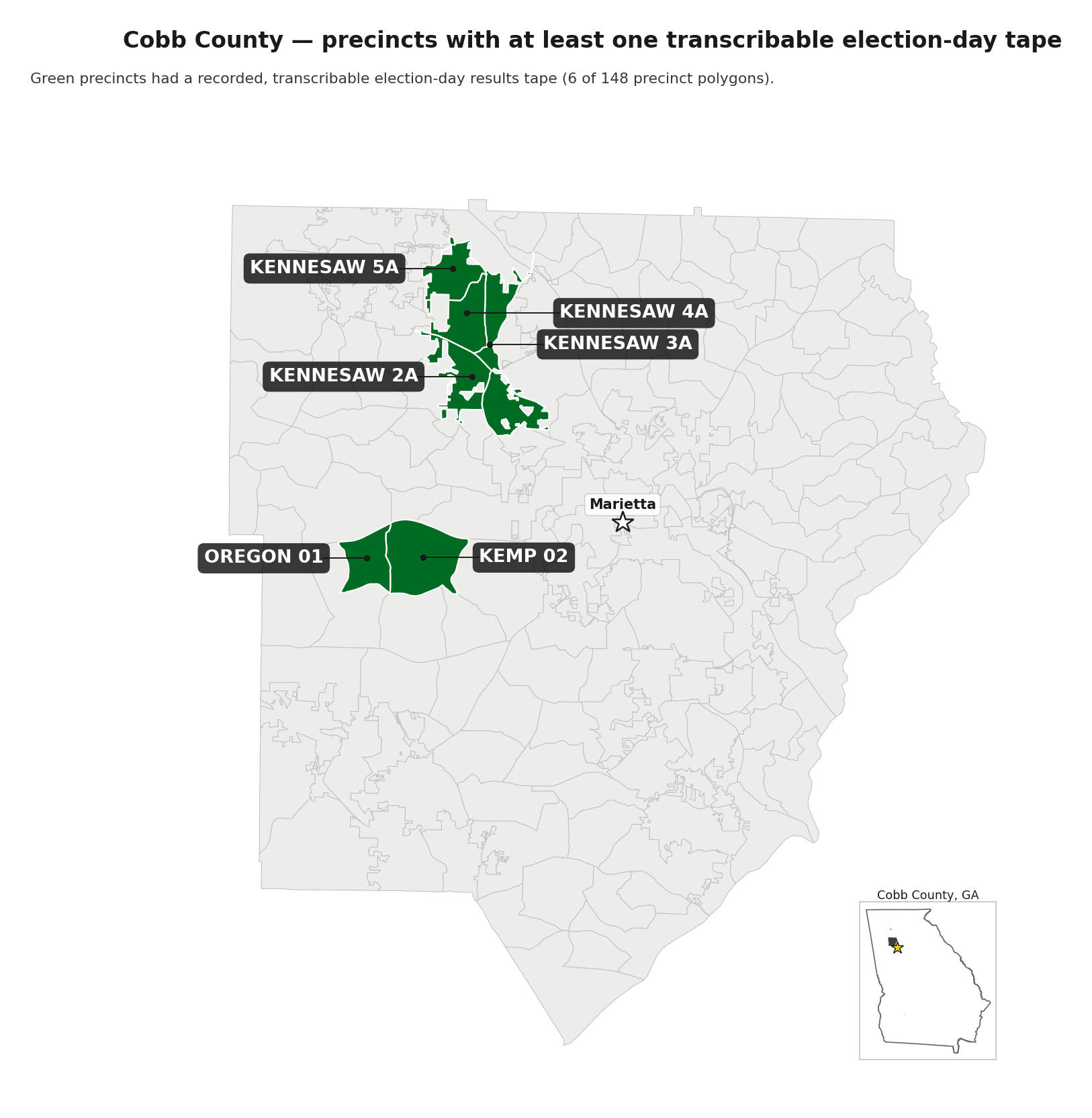
From 6 transcribable election-day poll tapes — one each from the Kennesaw 2A, 3A, 4A, and 5A, Oregon 01, and Kemp 02 precincts — we compared 88 values covering 6,496 votes against the officially published precinct results. All 88 matched exactly; zero apparent discrepancies, and nothing requiring a write-in or canvass explanation. A further 50 values transcribed from those same tapes had no officially published precinct counterpart to compare against — Georgia withholds many precinct-by-method results for voter privacy — and are reported separately throughout.
Our volunteers also recorded 18 advance-voting tapes. These cannot be compared against Georgia’s published results at all: in Georgia, any voter may vote early at any advance-voting location, and the published results redistribute those votes to each voter’s home precinct rather than reporting them by the scanner that counted them, so no published figure corresponds to what any one advance tape shows. To make the comparison possible, we asked Cobb County, as a public record, for the advance results grouped by the tabulator that counted them. The county provided the per-tabulator cast-vote records, and we compared all 18 tapes against them: 172 candidate-vote comparisons covering 73,953 votes, and every one matched the county’s certified count exactly. Independently, each tape’s printed ballot count also matched its tabulator’s advance-ballot total in the cast-vote records, confirming the tape-to-tabulator mapping (Section 6).
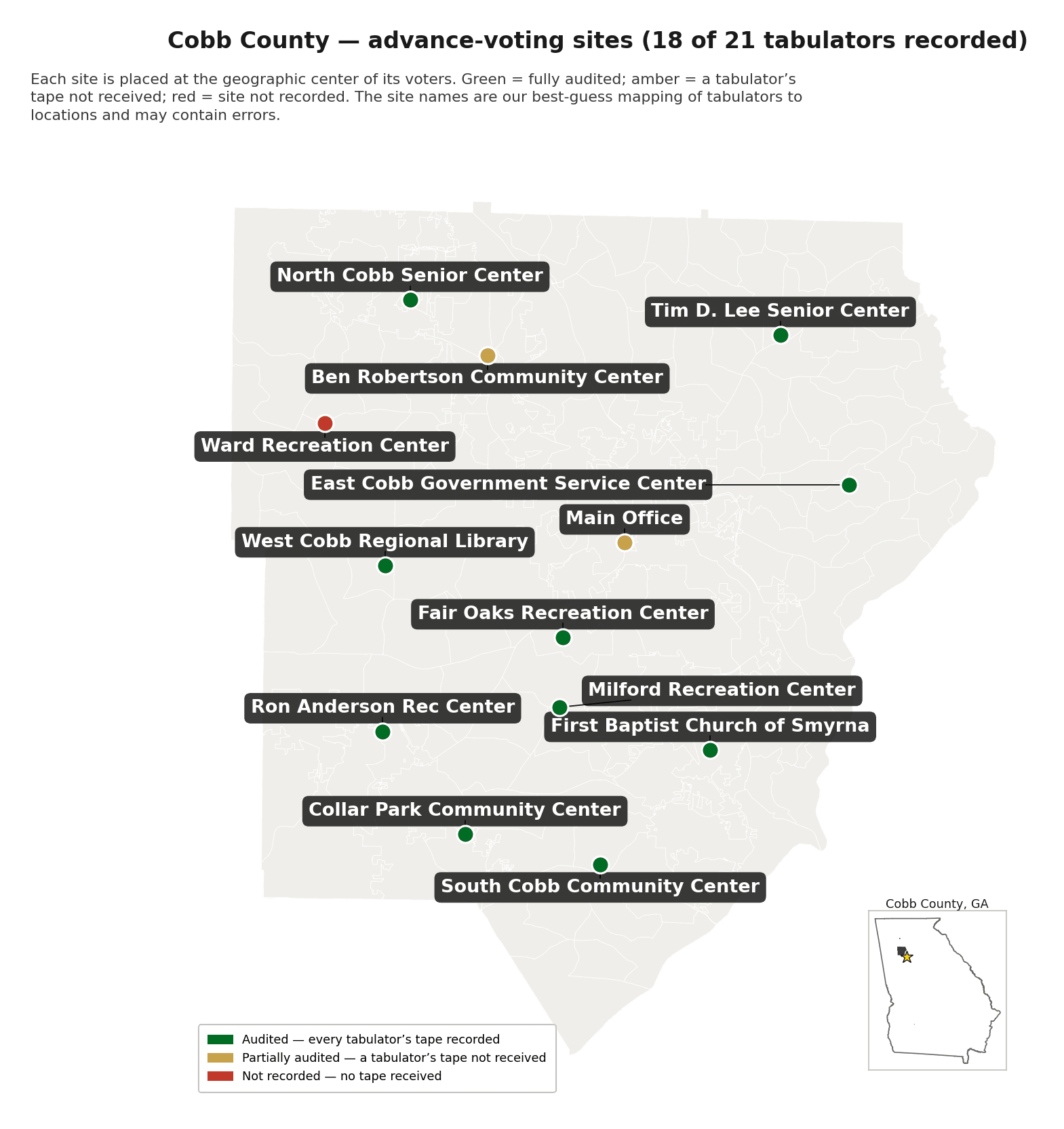
Those 18 tapes cover 18 of Cobb’s 21 advance-voting tabulators — about 87% of the county’s advance ballots. The three we did not receive are two additional tabulators at sites we did record (Main Office and Ben Robertson) and one whole site — the one the ballot data places at Ward Recreation Center — of 2,213 ballots. In a large volunteer recording effort a tape or two is easily missed — something gets mixed up or forgotten, especially without a per-tabulator checklist — so we flag these as coverage to capture next time, not as anything unresolved about what we compared. The advance-voting map in Section 10 shows all thirteen sites and which we audited.
Taken together, every comparison this analysis could make — 260 of 260 comparisons, 80,449 votes across election-day and advance voting — matched Cobb County’s official results exactly, with zero discrepancies of any kind. The only recordable figures still without an official counterpart are the 50 small-count election-day method breakdowns the Secretary of State’s office redacts for voter privacy; those are disclosed but, by design, unverifiable in either direction. We discuss the full result in Section 7.
4. Why This Analysis Matters
The stakes for accurate vote reporting in Georgia are as high as anywhere in the country, and Cobb County — one of the state’s largest — is central to them. In the 2020 General Election, the presidential margin in Georgia was 11,779 votes out of about five million cast — roughly 0.24% — and the race was counted three times (the original machine count, a full statewide hand-count audit, and a machine recount) before the result was accepted as settled. Statewide runoffs in Georgia have repeatedly been decided by margins of a point or less.
Margins this small should make everyone attentive. A single undetected vote-reporting issue — one transposed number, one memory card uploaded twice, one tabulator’s results attributed to the wrong place — could matter at that scale, and in a state with 159 counties and thousands of reporting units, random one-off human error can plausibly produce discrepancies of that order. So, in principle, could deliberate manipulation designed to look like error. The only way to know is to check, independently, against the physical record the machines themselves printed.
That is what this analysis does. The poll tape is the results document a scanner prints in public before any aggregation, upload, or transcription touches its numbers; comparing it to what the county ultimately published verifies precisely the steps in between. Here that check covered both election-day precinct reporting and — after a public-records request the county answered the same day — the advance vote, which in a modern Georgia election is the larger share. All 260 comparisons, covering 80,449 votes, matched exactly.
There is a second reason this particular analysis matters: it demonstrates a repeatable remedy for a structural transparency gap. Georgia’s published results cannot corroborate an advance-voting poll tape at all (Section 6); a narrowly drawn records request for the cast-vote records, grouped by tabulator, closes that gap completely — turning recordings that would otherwise sit uncheckable into an exact, independent confirmation of the county’s reporting. That template — documented in Vote Reporting in Georgia in our Technical Manual — is available to any volunteer group, in any Georgia county, for any election.
5. What Is an Actual Vote Analysis?
An Actual Vote analysis is an independent comparison of vote totals transcribed from poll tapes to the corresponding officially reported results, serving as a double-check of the accuracy of vote reporting.
Vote reporting is the process by which local-level vote totals from tabulating machines are aggregated to produce the official countywide and statewide results. This process is distinct from vote counting (which covers everything from voter registration through ballot tabulation). An Actual Vote analysis audits only the reporting step — not the casting, counting, or tabulation of ballots.
The methodology is an independent batch-comparison audit of the vote-reporting chain — the same tape-totals-versus-published-results check that risk-limiting audits perform on randomly sampled batches, conducted here at full coverage of the audited precincts. Batch comparison is a peer-reviewed technique that has been in use for over a decade: Colorado has run statewide risk-limiting audits built on it since 2017 (C.R.S. § 1-7-515), and the Election Assistance Commission, Verified Voting, and the Brennan Center for Justice all endorse rigorous post-election auditing. Actual Vote is not a risk-limiting audit — it does not compute or claim a statistical risk limit, and its claims extend exactly as far as its coverage.
For more information, see How Actual Vote Works and Why Actual Vote Is Trustworthy on our website. For the full technical methodology, see Section 8 of the Technical Manual.
6. Methodology Notes for This Analysis
How vote reporting works in Georgia
Georgia’s official results are published by the Secretary of State as structured per-precinct exports — one value per County × Precinct × Voting Method × Contest × Choice. Three Georgia-specific structures shaped this analysis (for Georgia’s poll-tape posting law, see Actual Vote in Georgia):
Election-day precinct tapes compare directly. On election day, a precinct’s scanner counts only that precinct’s in-person ballots, and the export reports an “Election Day” value for each precinct. So each election-day tape lines up one-to-one with its precinct’s Election Day column — the basis for the 88 comparisons in this analysis.
Advance voting is not comparable from the published results — but is comparable from the cast-vote records. Advance (early) voting happens at sites serving any voter in the county, and the published results redistribute those votes to each voter’s home precinct. A poll tape records the advance scanner’s blended per-tabulator total; the per-precinct export records home-precinct totals; no comparison exists between the two. (This structure — and the records-request remedy described next — is worked through in full in Vote Reporting in Georgia in our Technical Manual.) That is why the 18 advance tapes cannot be compared against the published results alone.
To make the comparison possible, we submitted an open-records request to Cobb County on July 1, 2026 for the advance results grouped by the tabulator that counted them; the county replied in full the same day — a response we greatly appreciate — with its Dominion cast-vote-record (CVR) export: one anonymized row per ballot, tagged with the tabulator that scanned it. Aggregating the advance-voting ballots by tabulator reconstructs exactly the unit a poll tape represents — the per-scanner totals — which restores a valid, like-for-like comparison. Each tape was joined to its tabulator by the tabulator ID printed on the tape, independently cross-checked by matching the tape’s printed ballot count to that tabulator’s advance-ballot count in the cast-vote records. Seventeen of the eighteen tapes matched on their “Total Scanned” line; the eighteenth (#5099) matched exactly on its “Total Voters” line (1,618), while its separate “Total Scanned” line prints 1,818 — the tape’s own two count lines differ, and the cast-vote records agree with the voter count. This is the basis for the 172 advance-voting comparisons in this analysis. The request was drawn narrowly, so that it sought no figure withheld for voter privacy.
Many precinct values are not published. The Elections Division of the Georgia Secretary of State’s Office withholds method-level results “in cases where not enough ballots were cast to ensure voter privacy,” shown in the export as a dash. For US Senate (Republican), 41 of Cobb’s 148 precincts publish no per-method breakdown. This is a deliberate, permanent privacy redaction — not pending data — and it accounts for the 50 values in this analysis that were transcribed from the tapes but had no published precinct counterpart. Section 6 quantifies it.
Data collection
Independent volunteers affiliated with Scrutineers, trained through America Counts’s Actual Vote program, video-recorded the results tapes that Cobb County posts publicly at the close of voting, using the Actual Vote app or device cameras. We received 24 submissions: 6 were election-day precinct results tapes (compared against the published precinct results), and 18 were advance-voting tapes (compared against the county’s per-tabulator cast-vote records, as above).
All poll tape recordings used in this analysis are publicly available at av.democracycounts.org (see Section 11).
What we recorded
On election day we captured six precincts:
| Precinct | Poll tape |
|---|---|
| Kennesaw 2A | #5104 |
| Kennesaw 3A | #5105 |
| Kennesaw 4A | #5106 |
| Kennesaw 5A | #5103 |
| Oregon 01 | #5107 |
| Kemp 02 | #5108 |
For advance voting we recorded 18 of the county’s 21 tabulators — close to all of it, but not quite. The colors below match the advance-voting map in Section 10:
| Advance-voting site | Tabulators recorded | Status |
|---|---|---|
| East Cobb Government Service Center | 1 of 1 | Audited |
| Tim D. Lee Senior Center | 2 of 2 | Audited |
| West Cobb Regional Library | 2 of 2 | Audited |
| First Baptist Church of Smyrna | 2 of 2 | Audited |
| North Cobb Senior Center | 1 of 1 | Audited |
| South Cobb Community Center | 2 of 2 | Audited |
| Ron Anderson Rec Center | 2 of 2 | Audited |
| Milford Recreation Center | 1 of 1 | Audited |
| Collar Park Community Center | 1 of 1 | Audited |
| Fair Oaks Recreation Center | 1 of 1 | Audited |
| Main Office | 2 of 3 | Partially audited |
| Ben Robertson Community Center | 1 of 2 | Partially audited |
| Ward Recreation Center | 0 of 1 | Not recorded |
Transcription and comparison
Poll-tape vote totals were transcribed from the video recordings by the Actual Vote pipeline’s AI vision system, which reads each tape’s contests and candidate totals across multiple video frames and reconciles them into a single value per contest and choice. The comparison was conducted in software: each election-day tape was joined to its precinct and compared to the officially published Election Day total, and each advance tape was joined to its tabulator and compared to that tabulator’s advance total aggregated from the cast-vote records; any mismatch was flagged as an initial non-match for investigation.
Human review is targeted where it matters most. A person adjudicated every flagged value against the recording — every initial non-match and every value the transcription marked uncertain — with values on bowed or blurry tapes read by hand from the video, and separately spot-checked a random sample of the values that matched on the first pass (published as the sample comparisons). This division of labor between the AI system and the human reviewer is deliberate: reviewing every value by hand would not scale, and it is also not what drives confidence here. The confidence comes from the structure of the check itself — the tape and the official results are two independently produced records, so systematic agreement between them is very hard to produce by accident, and any error in our own process surfaces as a mismatch to investigate, not as a false confirmation. Every advance-voting initial non-match resolved this way: each was a transcription artifact on a bowed or blurry tape, confirmed by re-reading the frame by hand and by the tape’s own printed totals — none was a genuine reporting difference.
Election-day official results were taken from the Georgia Secretary of State’s EnhancedVoting per-precinct export for the June 16, 2026 General Primary Runoff; advance-voting official totals were aggregated per tabulator from Cobb County’s Dominion cast-vote-record export, provided in response to an open-records request.
Definitions
A submission is the set of all videos and/or images submitted through the Actual Vote app or sent directly to America Counts that contribute to depicting one specific thing (most often a single results tape).
A transcribable submission is a submission that depicts a results tape with clearly readable header information and at least one legible contest/choice/vote total for comparison to official results.
A comparison is a transcribed value that can be matched one-to-one against an official value at the same grain — the published Election Day precinct total for the election-day tapes, or the per-tabulator advance total from the cast-vote records for the advance tapes. Values whose official counterpart is not available at that grain — chiefly Georgia’s privacy-redacted small-count method breakdowns — are not comparisons and are reported separately throughout.
For the full set of formal definitions used across all Actual Vote analyses, see the Technical Manual glossary.
7. Discussion of Results
No apparent discrepancies arose — on election day or in advance voting
Election day. All 88 comparisons matched exactly. Across the six election-day precinct tapes — Kennesaw 2A, 3A, 4A, and 5A, Oregon 01, and Kemp 02 — every candidate vote total printed on the physical tape equalled the value Cobb County published for that precinct, for 6,496 votes verified with zero apparent discrepancies and nothing requiring a write-in or canvass explanation. A few of these tapes were filmed at an angle or slightly out of focus; rather than guess, the transcription flags unreadable figures, and those were read by hand from the video. Every hand-read value also matched — the transcription degrades by flagging uncertainty, not by inventing a number.
Advance voting. Once Cobb County provided the per-tabulator cast-vote records (see below), the same check extended across all 18 advance tapes: 172 candidate-vote comparisons covering 73,953 votes, every one matching the county’s certified per-tabulator count. Independently, each tape’s printed ballot count matched its tabulator’s advance-ballot total (Section 6), confirming that every tape was joined to the right scanner. As expected with AI transcription of hand-held video, some values were transcribed incorrectly on the first pass and flagged as non-matches — most of them on a few tapes that had bowed away from the wall, curving the paper and making digits hard to read. Every flagged value was resolved by re-reading the frame by hand and by the tape’s own printed arithmetic (for example, on tabulator 2045 the State School Superintendent line reads Woods 1030 + Longgrear 826 = a printed total of 1856, matching the certified count exactly). All of them were Actual Vote transcription artifacts corrected to matches — noise from the reading process, handled by the review the pipeline is built around, never a reporting difference — so after adjudication zero apparent discrepancies remained.
Combined, this analysis made 260 comparisons covering 80,449 votes and found them all in exact agreement with Cobb County’s official results.
A records request was what made the advance comparison possible
The ceiling on what this kind of audit can verify is set not by what volunteers can record, but by what a jurisdiction publishes. In Georgia the largest piece of that gap is the advance vote — here 18 tapes, tens of thousands of ballots — which the published per-precinct results structurally cannot corroborate, because Georgia reports advance votes by the voter’s home precinct rather than by the scanner that counted them (Section 6).
A public-records request bridges it. We submitted one to Cobb County on July 1, 2026, for the advance results grouped by the tabulator that counted them — the same certified ballots, sorted by scanner rather than by home precinct — and the county replied in full that same day with a Dominion cast-vote-record export. We are grateful for so prompt and complete a response. Aggregated by tabulator, that data reconstructs exactly the unit a poll tape shows, and the comparison it made possible confirmed the advance vote to the same standard as election day. It is the model we would hope to see repeated: a documented gap, a narrow request, a cooperative response — with the result strengthening, not weakening, confidence in the county’s reporting.
One smaller structural gap remains, and it is a legitimate one. Within the six election-day tapes, 50 of the 138 values we transcribed had no published precinct counterpart, because the Georgia Secretary of State’s office withholds small-count method breakdowns for voter privacy. This is a deliberate, permanent privacy redaction rather than missing data; those values are disclosed here but, by design, cannot be checked in either direction. We did not seek to circumvent it, and our records request was drawn specifically to avoid any figure the county withholds for voter privacy.
What the comparison does and does not establish
This analysis provides direct evidence that Cobb County’s vote reporting was accurate wherever we could compare it: 80,449 votes verified with zero unexplained differences, spanning six precincts’ election-day results and 18 of the county’s 21 advance-voting tabulators, completed after the county certified the runoff. As with any coverage-bounded check, the strength of that statement extends exactly as far as the coverage — these precincts and tabulators — and no further; it does not speak to precincts or contests outside the recordings. This is an independent spot-verification of the reporting layer, not a risk-limiting audit of the count; its value lies in the confirmation itself, now covering both the election-day and advance vote, and in the documented, quantified account of the one small piece (privacy-redacted method breakdowns) that remains unverifiable by design.
Chain of custody and timing
The tapes were recorded from the results printouts Cobb County posts publicly at the close of voting, and both comparisons were completed after the county certified the runoff on June 23, 2026 (election day on June 25; advance voting on July 2, once the county provided the per-tabulator records). A post-certification comparison confirms that the certified, published results match what the machines printed; it is not a pre-certification design intended to surface reporting errors before results are finalized. The advance-voting official figures come from the county’s own cast-vote records, so that comparison checks the certified per-tabulator counts against the tapes those same machines printed.
Limitations of this analysis
This analysis covers the six precincts’ election-day results and 18 of the county’s 21 advance-voting tabulators for which we obtained transcribable recordings (we did not receive tapes for the other three, including one whole site — the one the ballot data places at Ward Recreation Center), each compared against the corresponding official figures. Absentee-by-mail and provisional ballots are not covered, nor are precincts and tabulators outside these recordings. The 50 election-day method values the Secretary of State’s office redacts for voter privacy have no official counterpart and are disclosed but unverifiable in either direction. Transcription was performed by an AI vision system with human review; where the automated reading of an advance tape was uncertain, values were confirmed by hand from the video and against the tape’s printed totals. All recordings remain public so that any reading can be checked independently.
8. Thanks and Acknowledgments
America Counts thanks the volunteers — independent recorders affiliated with Scrutineers who completed our Actual Vote training — who captured the Cobb County results tapes that are the evidentiary foundation of this report.
We especially thank the Cobb County Elections and Registration office. Every value we were able to compare — election-day and advance voting alike — matched the county’s official results exactly, which speaks well of the accuracy and care of their reporting. We are especially grateful for the office’s response to our open-records request: submitted on July 1, 2026, it was answered in full that same day. By providing the per-tabulator cast-vote records so promptly and completely, the county made it possible to extend this independent confirmation to the advance vote, and this report is stronger for it. In the same spirit, we encourage Cobb County and the Georgia Secretary of State to publish complete precinct-level results by voting method and per-tabulator advance results as a routine matter, so that confirmation like this is available to anyone without a records request.
9. Technical and Legal Notes
Non-partisan statement
This report is the work of America Counts, a non-partisan 501(c)(3) nonprofit organization. Working to improve election transparency and accuracy — including by issuing reports like this one — is inherently non-partisan. This report has no stated or implied partisan intent of any kind. For more on how and why America Counts maintains its non-partisan commitment, see Non-Partisan Election Advocacy on our website.
America Counts is a project of Democracy Counts, Inc. Our website is americacounts.us and our contact email is info@democracycounts.org.
Data sources
This report is based entirely on data that is either freely available to the public or available for free upon request. Poll tape data was obtained via video recordings taken with the Actual Vote app or with users’ device cameras, and transcribed by the Actual Vote pipeline’s AI vision system with human review. Election-day official results were taken from the Georgia Secretary of State’s public per-precinct results export for the June 16, 2026 General Primary Runoff. Advance-voting official results were aggregated from Cobb County’s Dominion cast-vote-record export, provided by the county in response to an open-records request (Section 6). All poll tape recordings used in this analysis are publicly available at av.democracycounts.org.
Conclusions and opinions
All analysis and conclusions in this report are the sole work and viewpoint of America Counts. They are not necessarily the opinion of any other person or organization, including the Georgia Secretary of State or any county election authority.
Accuracy of contextual information
Some information in this report about how vote reporting works in Georgia reflects educated guesses and inferences by America Counts based on publicly available resources, poll tape data, and our existing knowledge of election systems. Not all such information has been directly confirmed by the relevant election authorities. If you wish to use this information, proceed with appropriate caution and verify directly with the relevant election authorities where possible.
Using this report
This analysis was completed in two parts, both after Cobb County certified the June 16, 2026 General Primary Runoff on June 23, 2026: the election-day comparison on June 25, 2026, and the advance-voting comparison on July 2, 2026. The two are parts of one analysis — completing the election-day comparison first is what let us identify the advance-voting reporting gap and act on it promptly with the open-records request that closed it. While the data and analysis contained herein may be suitable for other purposes, no such suitability is expressed or implied by America Counts.
Note for election administrators
America Counts engages in vote report auditing in the spirit of teamwork, advocacy for election transparency, and civic engagement. We are deeply grateful to the many honest and professional election administrators across the United States. By undertaking this analysis, we are not representing any presumption that their work is inherently suspect or that error or fraud must have occurred. Independent audits of high-stakes systems are critical regardless of how well the people in those systems are performing.
Images
The header photo is of Sope Creek in Marietta, Georgia — in Cobb County, the subject of this analysis — by Sasha Price on Unsplash, used under the Unsplash License. All other images in this report are public domain, licensed by America Counts, or produced by America Counts.
Licensing
This report is released under a Creative Commons Attribution-NonCommercial-ShareAlike 4.0 International license (CC BY-NC-SA 4.0). You may remix, adapt, and build upon this work non-commercially, provided you acknowledge America Counts and do not imply endorsement.
10. Detailed Results
Maps
The discrepancy funnel
Where the automated transcription misread a value on the first pass — expected with AI transcription of hand-held video, and concentrated on bowed or blurry tapes — each flagged value was corrected to a match by re-reading the frame by hand and checking the tape’s own printed totals (§6). Across the whole analysis, 260 of 260 comparisons resolve to matches and 0 apparent discrepancies remain.
Transcribed values without an officially published counterpart
Of 310 comparison-eligible values transcribed from the tapes, 50 had no officially published election-day value for their precinct and contest — the official export omits the precinct × method breakdown (a voter-privacy redaction). By county:
| County | Values Without Published Counterpart |
|---|---|
| Cobb | 50 |
Submissions by county
| County | Total Submissions Received | Transcribable Submissions |
|---|---|---|
| Cobb | 24 | 24 |
Submissions by voting method
| Voting Method | Received | Transcribable |
|---|---|---|
| Advance Voting | 18 | 18 |
| Election Day | 6 | 6 |
Comparisons by county
| County | Comparisons |
|---|---|
| Cobb | 260 |
Vote coverage
How much of the county did we capture? By recording unit:
| Voting method | Recorded | In Cobb County | Coverage |
|---|---|---|---|
| Election-day precincts | 6 | 148 | 4% |
| Advance-voting tabulators | 18 | 21 | 86% |
| Advance-voting ballots (through those tabulators) | 28,790 | 32,962 | 87% |
And by votes: 80,449 votes were audited (6,496 election-day and 73,953 advance), against 413,721 officially reported contest-level votes in Cobb County across all voting methods — the denominator counts every reported candidate vote in every contest on the ballot.
| Jurisdiction | Votes Audited | Official Votes | Share Audited |
|---|---|---|---|
| Cobb | 80,449 | 413,721 | 19.45% |
| Georgia statewide | 80,449 | 6,273,672 | 1.28% |
Transcription quality checks
Results tapes print their own per-contest “Total Votes.” Where both it and the full line set were transcribed (133 contest blocks — 54 election day, 79 advance), 116 reproduce the tape’s total exactly from the transcribed values. The other 17 flag transcription gaps — an illegible candidate line or a misread printed-total line, published in the analysis archive; none affects the comparison, whose candidate values were all adjudicated against the official results.
11. Appendix: Video Links
Every transcribable submission used in this analysis is listed below — one row per poll tape. Click a thumbnail or submission ID to open the original video in the public Actual Vote Video Archive.
| Transcribable Submission | Preview | County | Precinct | Voting Method |
|---|---|---|---|---|
| ▶ 5087 |  | Cobb | AV-Central ICP 1 | Advance Voting |
| ▶ 5100 |  | Cobb | AV-East ICP 1 | Advance Voting |
| ▶ 5089 |  | Cobb | AV-Kennesaw ICP 1 | Advance Voting |
| ▶ 5093 |  | Cobb | AV-Mableton ICP 1 | Advance Voting |
| ▶ 5094 |  | Cobb | AV-Main Office ICP 1 | Advance Voting |
| ▶ 5096 |  | Cobb | AV-Main Office ICP 2 | Advance Voting |
| ▶ 5101 |  | Cobb | AV-North ICP 1 | Advance Voting |
| ▶ 5091 |  | Cobb | AV-Northeast ICP 1 | Advance Voting |
| ▶ 5090 |  | Cobb | AV-Northeast ICP 2 | Advance Voting |
| ▶ 5092 |  | Cobb | AV-Powder Springs ICP 1 | Advance Voting |
| ▶ 5095 |  | Cobb | AV-Powder Springs ICP 2 | Advance Voting |
| ▶ 5086 |  | Cobb | AV-Smyrna ICP 1 | Advance Voting |
| ▶ 5085 |  | Cobb | AV-Smyrna ICP 2 | Advance Voting |
| ▶ 5097 |  | Cobb | AV-South ICP 1 | Advance Voting |
| ▶ 5099 |  | Cobb | AV-South ICP 2 | Advance Voting |
| ▶ 5088 |  | Cobb | AV-Southwest ICP 1 | Advance Voting |
| ▶ 5102 |  | Cobb | AV-West ICP 1 | Advance Voting |
| ▶ 5098 |  | Cobb | AV-West ICP 2 | Advance Voting |
| ▶ 5104 |  | Cobb | KE2A | Election Day |
| ▶ 5105 |  | Cobb | KE3A | Election Day |
| ▶ 5106 |  | Cobb | KE4A | Election Day |
| ▶ 5103 |  | Cobb | KE5A | Election Day |
| ▶ 5108 |  | Cobb | KP02 | Election Day |
| ▶ 5107 |  | Cobb | OR01 | Election Day |